How Nanobubbles Can Make Aquaculture More Sustainable
Traditional aquaculture systems often face persistent challenges such as low dissolved oxygen (DO), water pollution from accumulated organic waste, disease outbreaks, and increasing reliance on chemical treatments. Against this backdrop, nanobubble technology offers a promising solution by improving oxygen transfer and supporting natural water-cleaning processes.
Specifically, nanobubbles are gas-filled spheres less than 200 nanometers in diameter, and because of their extremely small size, they remain suspended in water for long periods. As a result, they can influence water chemistry and microbial activity more effectively than conventional aeration methods.
What are nanobubbles and nanobubble systems?
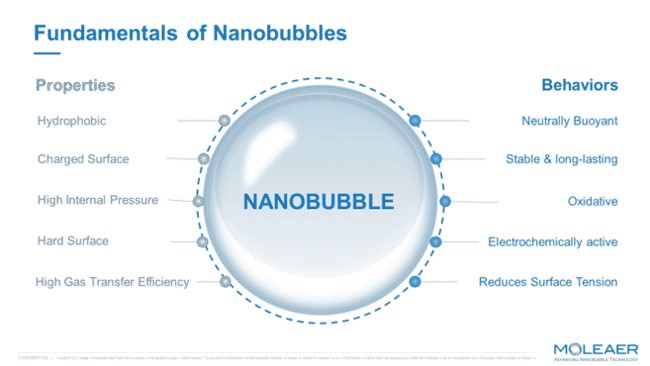
Nanobubbles are tiny gas bubbles, typically under 200 nanometers, that behave differently from larger bubbles. Because of their size, they do not rise quickly to the surface. Instead, they remain dispersed throughout the water column and gradually collapse over time, releasing oxygen efficiently and generating localized oxidative reactions in the surrounding water.
This stability leads to two key mechanisms: high oxygen transfer efficiency and oxidative effects. First, nanobubbles provide high oxygen transfer efficiency because they dissolve completely before reaching the water surface. Second, as nanobubbles gradually collapse, they generate mild oxidative reactions that, in turn, produce reactive oxygen species, which help inhibit harmful microorganisms.
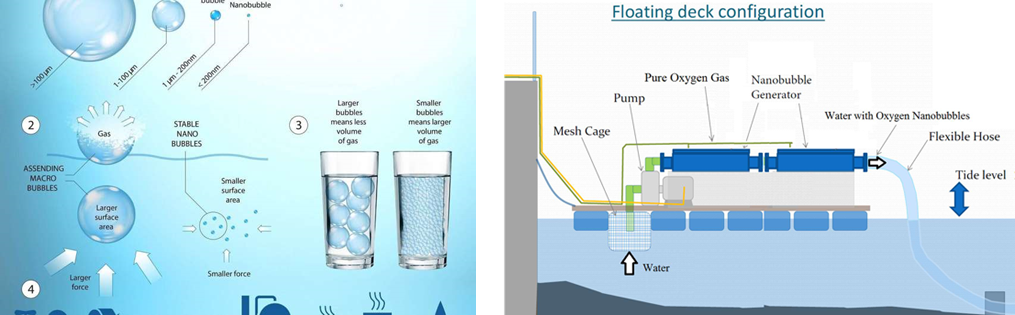
Nanobubble systems refer to the systems designed to generate and distribute these tiny bubbles on a practical scale. These systems generate nanobubbles using processes such as hydrodynamic cavitation (creating bubbles through rapid pressure changes in flowing water), ultrasonic agitation (breaking gas into tiny bubbles using high-frequency sound waves), or electrolysis (releasing gas bubbles through an electric current in water). Then, they distribute nanobubbles uniformly throughout ponds, tanks, and recirculating aquaculture systems (RAS), ensuring that oxygen is available in deeper water layers where conventional aeration is less effective.
Benefits of nanobubbles to aquaculture
-
Enhancing Water Oxygenation Efficiency: Nanobubbles improve dissolved oxygen (DO) because they dissolve gas more efficiently than traditional aeration, which often loses oxygen at the surface. With transfer efficiencies of 85-95%, water stays oxygen-rich and more stable compare to traditional systems. As a result, fish and shrimp breathe easily, face a low risk of hypoxia, and show steady growth and high feed conversion rate. These oxygenation benefits are especially useful in high-biomass systems or farms with limited water exchange.
-
Improving Water Quality: Nanobubbles also help clean the water naturally. As they collapse, they create small oxidative zones that break down organic waste and disrupt certain bacteria. Because of this mechanism, ammonia, nitrite, and fine organic particles degrade efficiently, leading to stable water conditions. In turn, farmers can rely less on chemical disinfectants and antibiotics. While nanobubbles don’t replace biological filtration, they improve its consistency.
-
Increased Productivity and Stocking Density: Thanks to high DO and clean water, farms can safely maintain high biomass without compromising environmental conditions. Because oxygen is distributed evenly throughout the pond or tank, stocking density can increase within safe limits. This allows farms with limited space to increase production output without expanding their land or facility footprint.
-
Enhanced Aquaculture Species Health: Stable oxygen conditions lower stress and support strong immune responses in fish and shrimp. With stable oxygen conditions, animals digest feed more efficiently and maintain steadier growth than in environments where oxygen levels are unstable or periodically low. As a result, farms experience fewer disease outbreaks and lower mortality than under unstable oxygen conditions.
How Nanobubbles Promote Environmental and Economic Sustainability
-
Reducing chemical use: Nanobubbles help reduce chemical use by disrupting biofilms-a layer of microorganisms on surfaces and slowing algal growth. They do this by creating small oxidative microzones that make it hard for microbes to attach and spread. As a result, farms may rely less on chemical treatments to manage algae or opportunistic pathogens compare to system without nanobubbles. The actual impact can vary depending on species, temperature, and organic load.
-
Supporting Cleaner Aquaculture Environments: Nanobubbles can also improve aquaculture environments by enhancing water clarity and reducing sludge buildup. They enhance the oxidation process of fine organic particles, helping them break down before settling on pond bottoms or tank loops. Because of this, few low-oxygen zones develop, lowering risks from harmful substances like hydrogen sulfide. Still, broader environmental claims, such as methane reduction, should be avoided without site-specific data.
-
Economic Sustainability: Nanobubble systems can lower operating costs over time by improving oxygen efficiency and reducing losses from disease. This comes from several mechanisms: lower aeration energy use, fewer chemical treatments, and better feed conversion supported by higher survival rates.
The Future of Nanobubble Technology in Aquaculture
The potential of nanobubble technology in aquaculture extends far beyond short-term operational improvements. As global seafood demand continues to rise, producers must find ways to increase output while maintaining environmental responsibility and system stability. Nanobubbles offer a practical pathway toward this goal by improving water quality, stabilizing culture conditions, enhancing animal performance, and supporting higher-yield production systems with lower resource intensity.
By integrating nanobubble systems into their operations, farmers can not only increase productivity and product quality, but also reduce risk, strengthen long-term system resilience, and move closer to a model of aquaculture that is both economically competitive and environmentally responsible. In this sense, nanobubbles are not merely a technological upgrade -they represent an important step toward the next generation of sustainable, high-performance shrimp and fish farming.
More Related Articles
Managing Alkalinity in Shrimp Ponds: Why It Matters and How to Increase It Using Lime