Indonesia’s October Exports Show a Sharp Decline Due to the Cesium-137 Related Challenges in the US.
Monthly Indonesian Shrimp Exports (January 2019 – October 2025)
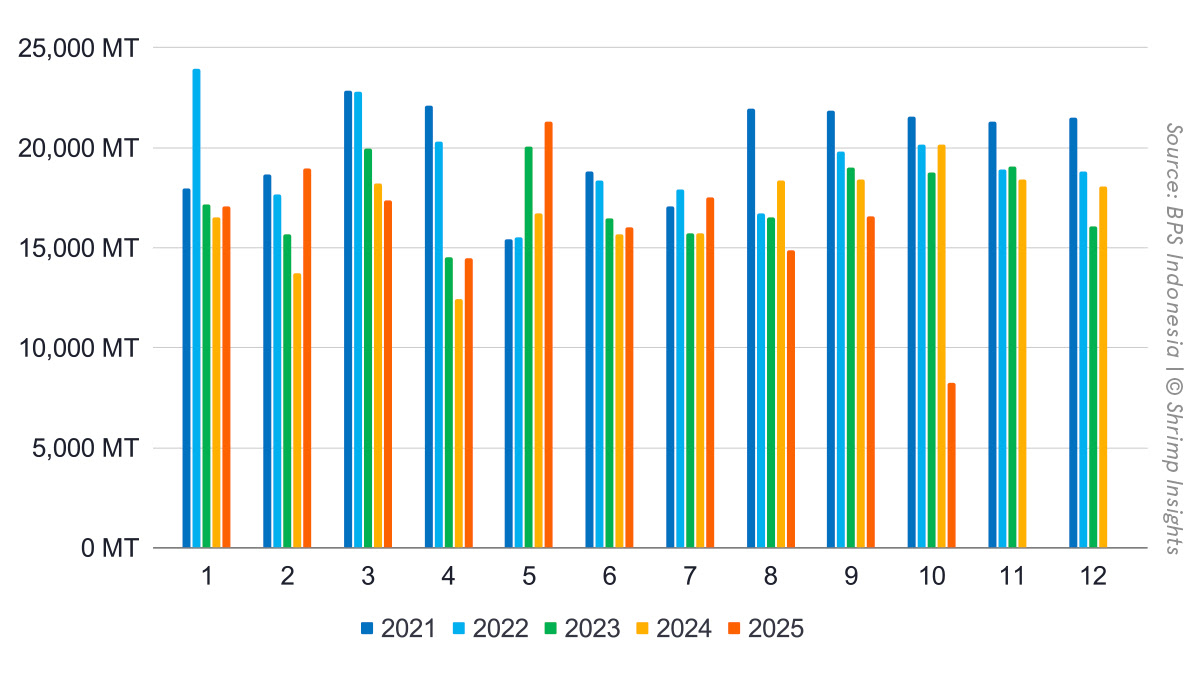
Indonesia’s shrimp exports collapsed in October, with volumes plunging to 8,233 MT, down 59% year-on-year, marking by far the weakest month of 2025. Export value mirrored this drop, falling to USD 76 million (-55% YoY). As a result, year-to-date volumes slipped back into negative territory at 162,434 MT (-2% YoY), while value remained firmly positive at USD 1.41 billion (+8% YoY)—underscoring how sharply October deviated from an otherwise resilient year.
Products
The October correction was broad-based across all product categories. Raw L. vannamei, Indonesia’s core export item, fell to 3,868 MT (-60% YoY), halving volumes compared to the summer months. Cooked and marinated shrimp, which had been one of the strongest performers earlier in the year, dropped even more sharply to 1,696 MT (-67% YoY). Breaded shrimp declined to 441 MT (-57% YoY), continuing the weakness already visible since August. P. monodon proved relatively more stable but still declined to 872 MT (-11% YoY). Despite the October shock, YTD figures still show growth for value-added categories, particularly cooked and marinated shrimp at +11% YoY.
Markets
The collapse in October exports was overwhelmingly driven by the United States. Shipments to the US fell to just 1,860 MT, an 86% year-on-year decline, compared with monthly volumes of around 10–14 thousand MT earlier in the year. This single market shock explains most of Indonesia’s overall October contraction.
In contrast, Japan moved counter-cyclically, with October volumes rising to 3,467 MT (+20% YoY), making it Indonesia’s largest market that month. EU-27 imports continued to expand year-to-date (+47% YoY), although October growth moderated to +7% YoY. China and Canada both declined in October but remain positive on a YTD basis.
Cesium-137: the key disruption behind October
The dramatic fall in US-bound shipments is closely linked to the ongoing cesium-137 contamination concerns that surfaced in mid-2025. Heightened scrutiny and testing requirements by US authorities led to shipment delays, holds, and, in some cases, rejected or postponed consignments. In early December, the Indonesian government announced that it had released more than 600 containers that had undergone the Cesium-137 testing protocol and had been declared free. This may be the start of the normalization of Indonesia-US shrimp exports. While we expect November exports to show an equally sharp decline, December exports may decline slightly less sharply, and in the first half of 2026, exports may gradually return to previous levels.
From Shrimp Insight